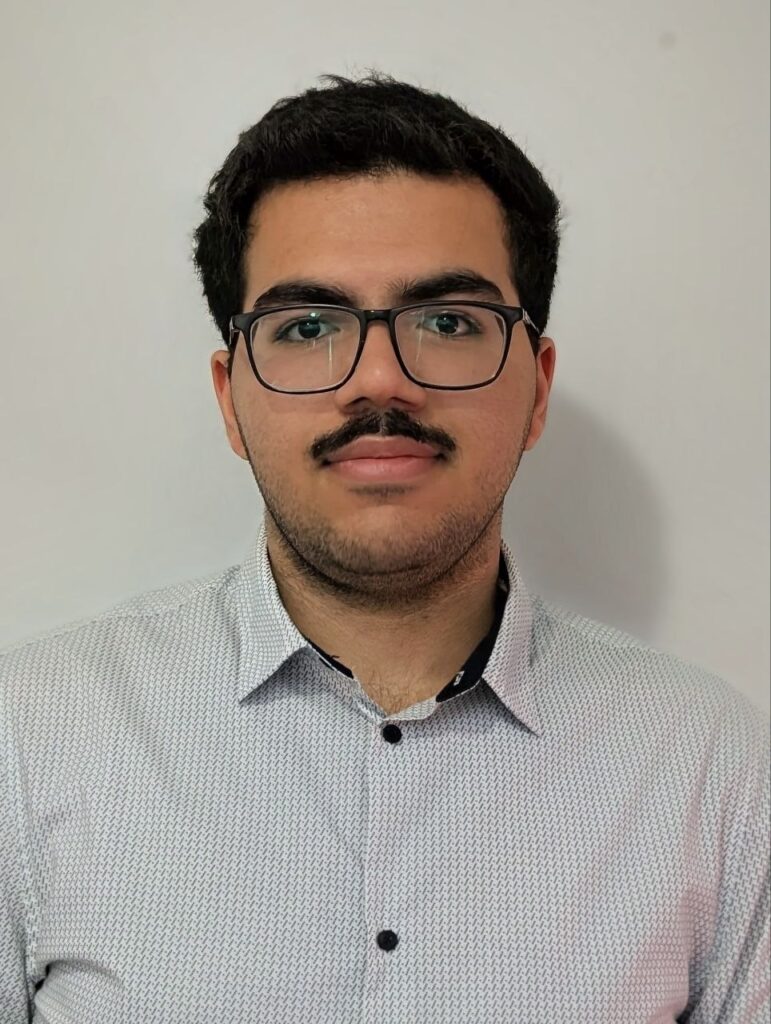
Meet Aria Azadi Pour, Software and Business Development Intern at Global Maritime, as he discusses his role within the Products & Innovation team, the growing influence of AI, and how OPSIM helps support better decision-making for complex offshore operations.
Currently studying Computer Science at Memorial University of Newfoundland and Labrador, Aria brings more than four years of experience as a full-stack developer, having worked across a range of start-up and technology ventures.
Since joining Global Maritime, he has expanded his expertise into business development, marketing and offshore simulation, supporting the development and promotion of OPSIM while helping clients explore more informed, data-driven decision-making. Passionate about solving complex problems, Aria enjoys combining software, innovation and practical engineering to deliver real-world solutions.
Tell us a bit about your role and what it entails?
My role generally involves work in three categories, business development, marketing, and software development. Depending on the day, I could be working on finding new sale leads, generating marketing materials, or conducting code reviews and suggesting software processes.
Can you walk us through your career path to date?
I started coding very early, at 10 years old. Not much, but, small personal projects and some freelance work happened in the next five years. At age of 15, I attended a coding bootcamp and afterwards started working on contractual basis. For the next few years, I worked mainly as a full-stack developer for various companies working in diverse fields such as cryptocurrencies, investment, and tourism. And now I’m working at Global Maritime in a role that combines business development and software development, giving me my first experience in business development and marketing.
Tell us about your role within Global Maritime’s Products & Innovation team and how you’re involved with OPSIM?
I play a diverse role within the Innovation & Products team and my work on OPSIM is a good point to showcase that. I started by learning to work on OPSIM, which was an easy day long task with the tutorials included inside OPSIM. And from then on I’ve been working on understanding the clients and their use cases, helping find new clients, and developing marketing material for OPSIM. I also use OPSIM for modelling work myself to better understand its strong suits and short falls when it comes to different types of work.
What is OPSIM and what challenges does it solve?
OPSIM is a discrete event simulation software with specialised support for weather forecasting. OPSIM gives you the building blocks to simulate any real world event that can be modelled discretely. Where OPSIM really shines is when it comes to any uncertainties with involving weather. The ease with which you can simulate weather events in OPSIM is unlike any other software I’ve seen. This helps a lot in simulating weather-dependent events such as offshore operations, transportation and installation, vessel and resource allocation, O&M execution, personnel resourcing, and much more.
How can simulation support more informed decision-making?
Simulation helps reduce the unknowns and become more clear on the assumptions made. Particularly, you will be more able to know how those assumptions hold up vs real world data and conditions.
Opsim’s capabilities really shine through when it comes to offshore and weather related tasks and events. You will have a very hard time trying to estimate how long a weather-dependant event will take just from a spreadsheet; you may know the duration of the tasks and what kind of weather window is needed but at best you’ll be able to estimate, with a lot of uncertainty, how long it will take to finish this task.
Opsim gives you an easy way to define weather windows. Then, you can run the simulation through various weather conditions using historical hindcast data. This can give you a lot of useful info, not least, probability of completion which gives you an idea of for example what is the maximum time it took for 90 percent of simulation that started in July to finish. The utility of this kind of info is beyond anything a simple spreadsheet can provide.
How has your career evolved at Global Maritime?
This has been a very variable role to me. I have learnt a lot about business development and marketing, a field in which I used to have little knowledge and no experience. I’ve also gathered knowledge on the inner workings of enterprise-level companies and helped develop and understand software processes for companies in such scale. Most of my previous experience has been in start-ups which while valuable left a hole in my expertise.
What inspired you to pursue a career within our industry?
I’ve always been interested in complicated problems and problem solving and the work of Global Maritime involves a lot of interesting problems and great problem solving skills. Getting to know various aspects of cutting-edge marine engineering has been a great experience.
How are the trends we’re seeing right now affecting your role as a whole?
One of the main trends dominating my role right now is AI. AI has massively changed how software development is done on many levels and there is much more uncertainty about the shape and future of software development right now than there has been throughout my career. Learning to use AI properly and in the right places has immensely improved my capabilities in my current role and has helped kick start my experience in fields where I didn’t have much knowledge in.
What advice would you give to someone entering Software Engineering today?
I would tell them to stay open-minded and curious. Software is facing a lot of change and the best way to keep up is to have a natural curiosity and interest in this field.
What’s your favourite thing about being part of the Global Maritime team, beyond the day-to-day work?
The people are definitely my favourite part of being at Global Maritime. The team is incredibly supportive, approachable, and always willing to help. The relationships I’ve built with my colleagues go beyond work, creating a genuinely positive and enjoyable environment. I’m fortunate to work alongside talented and knowledgeable people, and there are always interesting, thought-provoking conversations that make every day rewarding.
What does life look like for you outside of Global Maritime?
It is mostly consisting of my hobbies, more coding and some cooking, spending time with friends and family and working on my own startup, trying to contribute to the circular economy here at Newfoundland and Labrador.
To learn more about Global Maritime’s software solutions, visit our Software page Proprietary Software – Global Maritime